
Speaker
presence is built, not born
What makes speakers captivating, how do I structure what I say for clarity and impact, and what does real practice actually look like?
You don't have a knowledge problem.
You have a delivery problem.
You know your subject cold, but the moment you open your mouth it comes out flat, rambling, or rushed. There's no structure for turning what you know into spoken delivery — so people respect your expertise but drift before you land it. Hit close to home?
You treat speaking as a talent. You assume good speakers are naturally charismatic — instead of seeing that structure and practice built the delivery you're admiring.
You write scripts instead of outlines. Reading or reciting memorized text kills natural delivery — and makes recovery from a single stumble nearly impossible.
You practice without a rubric. You watch yourself back with vague self-judgment, so "I'm bad at this" replaces the specific, fixable feedback that would actually help.
You focus on content and ignore delivery. You know exactly what to say but never work on how to say it — so real expertise gets buried under flat energy and poor pacing.
From "I know it but can't deliver it" to I own the room
"I know my subject inside and out but when I speak, it doesn't land the way it should. I rush through the important parts, ramble during transitions, and my energy is either flat or nervous. People respect my expertise but they don't stay engaged."
"I speak with deliberate pace, clear structure, and energy that matches the moment. I know how to open strong, transition cleanly, and close with impact. My delivery feels natural because I've practiced it — not because I'm winging it."
The shift: speaking well isn't about charisma or extroversion — it's about structure, pacing, and repetition. Presence is built, not born. The speakers who look natural practiced until the structure became invisible.
You don't just watch lessons.
You leave with 12 real artifacts.
Working documents you actually use — not a vague "be more confident" pep talk. By the end they add up to a delivery framework, a practice system, and the presence to match your expertise.
Energy Calibration Guide
Intensity levels mapped to each speaking format you use.
Pacing Toolkit
Pause placement, speed variation, emphasis techniques.
Body Language Checklist
Camera and stage habits to adopt and eliminate.
Presence Application Guide
Presence techniques for your directory / niche formats.
Delivery Framework Template
Hook, body, transitions, close — adaptable to any format.
Speaker Outline Template
Structured enough to stay on track, loose enough to sound natural.
Format Adaptation Guide
5-min, 30-min, 60-min, and panel structures.
Delivery Structure Templates
Speaking structures for your directory / niche.
Self-Review Rubric
Specific criteria for evaluating your own recordings.
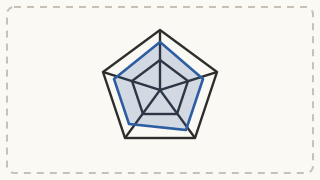
Targeted Drill Library
Exercises for filler words, pacing, monotone, trailing off.
Weekly Practice Log
Improvement tracking, week over week.

Speaking Opportunities Calendar
Planned reps across your directory / niche platforms.
Three moves: find your voice → structure delivery → own the room
Presence
Energy · pace · bodyCalibrate your energy, control pace, and command the camera or stage.
- Energy Calibrate your intensity to the format you're in
- Pace Use silence, speed, and pauses to control attention
- Body Master posture, gestures, and eye contact on camera and stage
- Apply Bring presence to your directory / niche speaking formats
Preparation
Framework · outline · adaptBuild a delivery structure, outline it, and adapt to any format.
- Framework Build a delivery structure — hook, body, transitions, close
- Outline Create speaker outlines that keep you on track, not rehearsed
- Adapt Adjust your structure for 5-, 30-, and 60-minute formats
- Apply Structure delivery for your directory / niche contexts
Practice
Record · drill · iterateReview with a rubric, drill weaknesses, and improve every week.
- Record Review your own delivery against a specific rubric
- Drill Target filler words, rushing, monotone, and trailing off
- Iterate Build a practice cadence that produces measurable improvement
- Apply Find speaking reps inside your directory / niche platforms
More than videos —
a learning system
Every lesson lives in a platform built to help you actually absorb, apply, and return to the work.
AI Chat per lesson
Ask questions and pull key points, action items, and reflections from any lesson.
Searchable transcripts
The full text of every video — search it, scan it, jump straight to the part you need.
Highlights
Mark the passages that matter and filter the transcript down to just your highlights.
Bookmarks
Save the exact moments you'll want to come back to and reopen them in a click.
Notes
Keep personal notes saved right inside each lesson, exactly where you wrote them.
Playlists
Build custom collections of lessons and sequence the path that fits you.
Certificate
Auto-issued the moment you complete every lesson in the course.
Podcast mode
Listen to the course as audio in any podcast app — learn on the move.
Video controls
Closed captions, speed controls, picture-in-picture, and theatre mode — watch your way.
Favorites
Heart any lesson to pin it to your favorites for quick access later.
History & resume
Pick up exactly where you left off — your place is always saved.
Threaded comments
Discuss each lesson with other students in threaded conversations.
Is this course your right next step?
This is for you if…
- You speak regularly — calls, webinars, videos, podcasts, presentations — but your delivery doesn't match your expertise.
- You rush key points, ramble on tangents, or default to flat energy because you're focused on content.
- You know your material cold but it comes out flat, rambling, or rushed when you open your mouth.
- You want presence techniques, a delivery structure, and a practice system that actually builds improvement.
- You want 12 real artifacts ending in a delivery framework and a practice log — not "just be more confident."
This is NOT for you if…
- You haven't built a content system yet — start with Execution (System 1 of Fundamentals) first.
- You're already a polished, in-demand speaker looking for advanced platform craft.
- You want someone to write and deliver your talks for you — this builds your own delivery.
- You think charisma is something you either have or don't — this is structure and practice, and it works regardless.
Be one of the first to tell your story
These courses are brand new. Once you've done the work, tell us how it changed your thinking — your words could be the first testimonial featured right here.
"Here's how this course changed the way I…"
your story here
"The part that surprised me most was…"
your story here
Three ways to go deeper
This course is one piece of a bigger system. Here's the whole map — and where you are on it.
University
Learn at your own paceThis course — full University access is $80 on its own.
Launchpad
Get the tools to execute-
Ebook$10narrative deep-dive
-
Checklists$15self-assessment diagnostic
-
Journal$20reflective application + AI prompts
-
Workbook$25full execution tracker
One of each — the full toolkit for this course is $70 on its own.
You're buying the University piece — the course, its platform, and the artifacts you produce. Bundle all three and save — see pricing below. Each column is also available à la carte: University $80, Launchpad $70, Events $280. See how we build →
Everything. Course price.
Lock in the full bundle today. Every piece ships to your account as it's built — and the price only goes up from here.
$430 value when complete
Everything, for the price of just the course.
- 12 lessons + AI Chat, transcripts, highlights, bookmarks
- Ebook + Checklists + Journal + Workbook shipping soon
- Workshop + Sprint + Challenge access shipping soon
- Certificate on completion
- Clinics included free — $20 each on their own
The price goes up as content ships — the founding price never comes back.
Not ready to commit? Attend our live workshops, sprints, and challenges for free — just show up. No signup, no credit card. If you like what you experience, the founding price locks in everything permanently.
Every piece below ships to your account as it's built — free, at your founding price:
- Speaker — 12 lessons Digital$80 valueLive now
- Ebook Digital$10 valueIncluded
- Checklists Digital$15 valueIncluded
- Journal + AI Prompts Digital$20 valueIncluded
- Workbook Digital$25 valueIncluded
- Workshop Events$40 valueIncluded
- Sprint Events$80 valueIncluded
- Challenge Events$160 valueIncluded
- Total value when complete$430You pay $80
↑ as the tools ship, the price rises
↑ as the live events go up, it rises again
Full $430 value, fully builtWhat ships when?+
- Week 1: Workshop Part A (courses 1–3) + Ebook ships.
- Week 2: Workshop Part B (courses 4–6) + video lessons go live + Checklists ship.
- Week 3: Sprint recordings + Journal ships.
- Week 4: Challenge recordings + Workbook ships.
Or start bigger — the same deal at every scope:
Course
1 course + tools + events
$80System
All 6 Skills courses
$320Pillar
All 36 Fundamentals courses
$960University
All 324 courses
$4,320Same deal at every scope — everything included, price goes up as content ships. See How We Build →
Prefer one piece? Single University, Launchpad, or Events access. · See How We Build →
Founding Access — Speaker
Full bundle (University + Launchpad + Events) · $80 · pre-sale founding rate
[ Simplero checkout / order-form embed renders here ]
Wire this to the Simplero Founding bundle product for this course.
The fifth step of the Skills journey
Speaker is course 5 of 6. Live delivery builds on everything before it — time discipline, story structure, written preparation, and recording comfort all converge the moment you speak. Speaker turns expertise into presence whether you're on a call, a webinar, or a stage — then Images makes the visuals match the voice.
You are here — own the room.
You're not doing this alone
Every lesson has a discussion where you share your work and read how others approached the same prompt — so you see the patterns, not just your own answer.
“Post your experience, read two others, and notice the patterns.”
Per-pillar discussion forums are coming as the community grows.
Before you decide
I'm an introvert — can I really become a good speaker?+
Speaking well has nothing to do with extroversion. Introverts often make better speakers because they prepare more deliberately. This course is about structure and practice, not personality change — you don't have to become someone else.
Do I need to speak on stage, or is this just for video?+
Both, and more. The principles apply to any format: video, podcast, webinar, one-on-one calls, group coaching, and live stages. You'll adapt the framework to your actual speaking situations — not a generic keynote you'll never give.
How much practice time does this take?+
15–20 minutes per week of deliberate, recorded practice produces noticeable improvement within a month. It's about quality of reps, not volume — a focused fifteen minutes beats an unfocused hour.
I freeze up or go blank — will structure help?+
That's exactly what it fixes. An outline — not a script — gives you a path to follow, so a stumble becomes a quick recovery instead of a derailment. Most freezing comes from trying to recall memorized text; structure removes that trap.
I run a directory business — does this still apply?+
Yes. The fourth lesson of each module applies presence and structure to directory-specific speaking — member calls, community events, walkthrough presentations — with a parallel niche track if you're not running a directory.
What do I actually walk away with?+
12 working artifacts — from an energy calibration guide and delivery framework to a speaker outline template, a self-review rubric, a targeted drill library, and a weekly practice log.
What makes speakers captivating, how do I structure what I say, and what does real practice look like?
Stop letting flat delivery bury your expertise. Build presence, structure what you say, and practice until it looks effortless.